
Most large organizations know a great deal about themselves.
They know their processes. They have policies. They maintain organization structures, application inventories, risk registers, controls, customer journeys, KPIs and transformation portfolios.
Yet ask a seemingly simple question:
If we change this, what else changes?
And the answer can become surprisingly difficult.
The problem is rarely a lack of information.
The problem is that the information exists across different functions, systems and management disciplines, while the enterprise itself does not operate that way.
A process crosses departments. A policy affects activities and decisions. Applications enable processes. Processes consume data. Risks arise inside operations. Controls mitigate those risks. Authority determines who can commit the organization. Customer journeys cut across all of them.
Transformation changes these relationships.
And when those relationships are not visible, organizations can make significant transformation decisions with only a partial view of their consequences.
You can't transform what you can't see. And seeing the pieces is no longer enough. You need to see how they connect.
The enterprise is fragmented on paper, not in reality
Consider a typical transformation.
An organization decides to automate an important end-to-end process.
The business case may look straightforward: reduce manual work, improve turnaround time, lower cost and create a better customer experience.
Then the team examines what actually sits behind the process.
It crosses several functions. Multiple applications support different stages. Policies determine how particular transactions must be handled. Controls exist because certain activities carry financial or regulatory risk. Different roles execute and approve different actions. Data comes from multiple sources. Authority may change according to transaction value or circumstance. And the customer experiences the process differently from the way the organization has structured it internally.
So what exactly are we automating?
A process?
Or a connected operating system of people, policies, technology, data, controls, authority and customer interactions?
This distinction matters because enterprises tend to manage these elements separately.
Processes may sit with Operational Excellence. Applications with IT or Enterprise Architecture. Policies with Governance. Risks and controls with Risk or Compliance. Customer journeys with CX. Organization structures with HR. Transformation initiatives with the PMO.
Each view may be correct.
But none represents the whole enterprise.
This is one reason transformation in functional silos remains difficult. Recent research continues to identify outdated workflows, fragmented governance and departmental silos as barriers to end-to-end reinvention, while operating-model research similarly emphasizes bringing business, technology and operations closer together.
But there is another layer to the problem.
The knowledge those silos own is fragmented too.
Transformation changes relationships
Organizations frequently start transformation with a solution:
- Which technology should we implement?
- Which processes should we automate?
- Which applications should we rationalize?
- Where should we deploy AI?
- Which activities should move into Shared Services?
All are legitimate questions.
But they are downstream questions.
Before changing an enterprise element, there is another question worth asking:
What is this connected to?
Take a business process.
It may support a strategic capability, cross several organizational units, interact with a customer journey, rely on multiple applications, consume critical data, be governed by policies, contain operational risks and controls, and include decisions requiring specific levels of authority.
Change the process and some of those relationships may need to change with it.
The same applies in reverse.
Change a regulation and policies, controls and processes may be affected. Retire an application and the processes depending on it need attention. Change a Delegation of Authority and decision mechanisms across multiple workflows may change. Introduce an AI agent and suddenly process, policy, application, data, risk, control and authority all become relevant.
The real transformation object is therefore rarely an isolated process, application or organizational unit.
It is the network of relationships surrounding it.
Documentation is not enterprise context
Organizations have spent decades documenting themselves.
And they should.
Process maps. Policies. Architecture models. Risk registers. Application inventories. Data catalogs. Organization charts. Customer journeys. Transformation portfolios.
All are valuable.
But documentation and context are not the same thing.
A process model tells us how work flows. A policy tells us what is required. An application inventory tells us what technology exists. A risk register tells us what could go wrong. A Delegation of Authority tells us who may exercise particular authority.
Enterprise context emerges when the relationships between these elements become explicit.
Now we can ask:
- Which policies govern this process?
- Which applications enable it?
- Which roles perform it?
- Which customer journey does it support?
- Which data does it consume and create?
- Where are the risks?
- Which controls mitigate them?
- How is performance measured?
- Which decisions occur within it?
- Who is authorized to make those decisions?
And, critically:
If one of these elements changes, what else is affected?
This is the difference between storing information about the enterprise and understanding how the enterprise works.
DNA's Business Process Excellence approach has reflected this philosophy for years. It extends beyond process discovery and modeling into process ecosystem analysis, performance, ownership, improvement, simulation, compliance, transition, governance and collaboration.
The process map is valuable.
The relationships around the process are where much of the transformation intelligence resides.
From information to impact
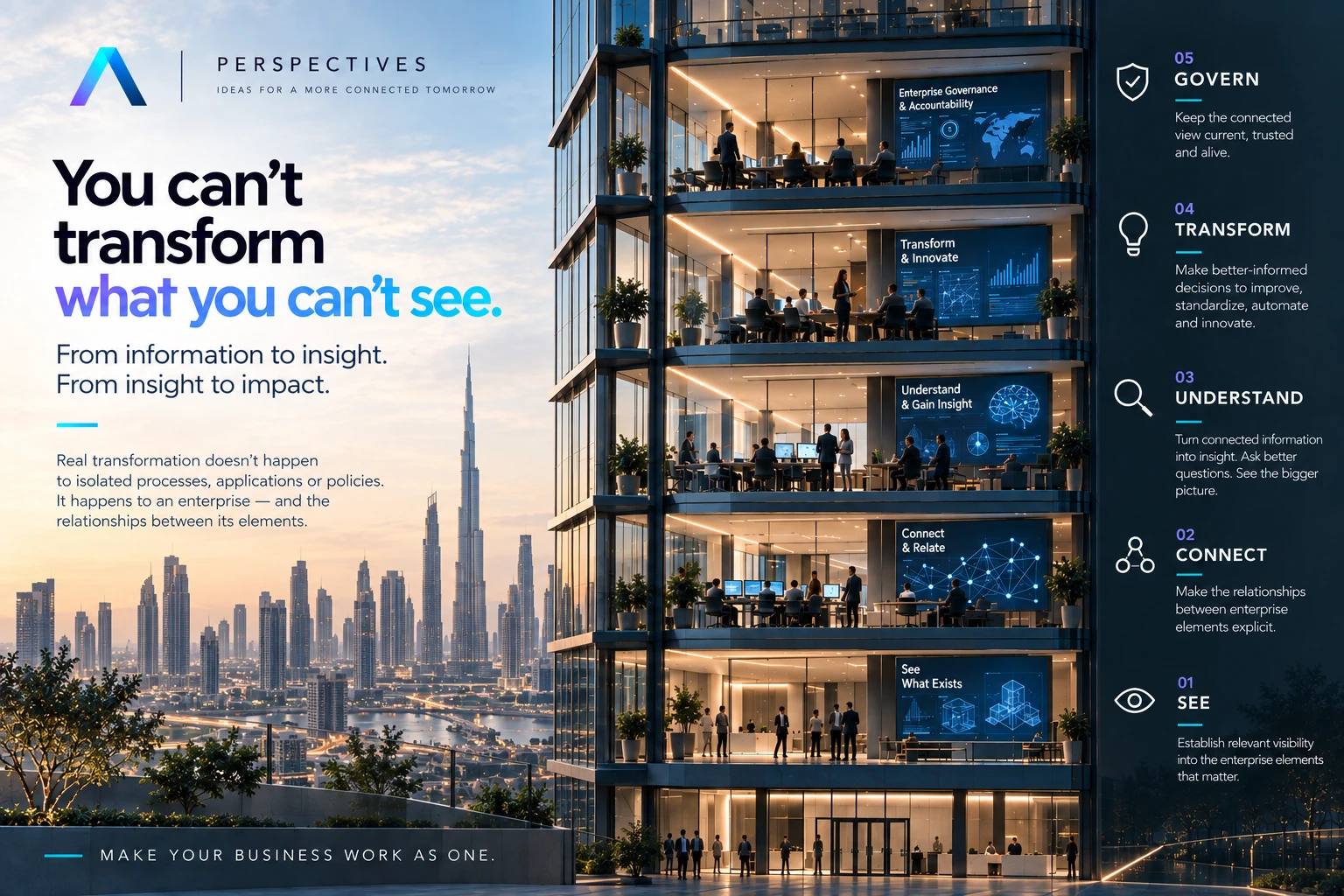
SEE → CONNECT → UNDERSTAND → TRANSFORM → GOVERN
The progression is deliberately simple.
01 — SEE
Back to image & frameworkWhat exists?
Establish relevant visibility into the enterprise elements that matter.
Depending on the problem, these may include:
Strategy · Capabilities · Processes · Policies · People · Applications · Data · Risks · Controls · Authority · Customer Journeys
This does not mean documenting the entire enterprise before changing anything.
That can create another problem entirely.
The objective is relevant visibility.
02 — CONNECT
Back to image & frameworkHow does it relate?
Make the important relationships explicit.
Strategy ↔ Capability ↔ Process
Process ↔ Role
Process ↔ Application
Process ↔ Policy
Process ↔ Data
Process ↔ Risk ↔ Control
Process ↔ Authority
Process ↔ Customer Journey
This is where information starts becoming enterprise context.
03 — UNDERSTAND
Back to image & frameworkWhat does it mean?
Connected context allows better questions.
Where are the bottlenecks? What is duplicated? Where is ownership unclear? Which customer pain point originates somewhere upstream? Which processes depend on technology scheduled for retirement? Where do policy and operational reality diverge? Which controls overlap? What will this transformation initiative affect? Why does execution differ between markets?
The objective isn't a bigger repository.
It is better organizational understanding.
04 — TRANSFORM
Back to image & frameworkWhat should change?
Now the organization can make better-informed decisions about where to:
Improve · Standardize · Redesign · Automate · Rationalize · Consolidate · Digitize · Apply AI
Connected context does not remove transformation risk.
It reduces the amount of transformation performed without understanding the surrounding dependencies.
05 — GOVERN
Back to image & frameworkHow does it remain true?
This is where many initiatives eventually weaken.
Organizations continuously change.
Processes change. Policies change. Applications change. People change. Regulations change. Markets change.
If the connected enterprise view does not evolve with the organization, today's source of truth becomes tomorrow's archive.
Ownership and governance are therefore not administrative additions.
They are what keep enterprise context alive.
What enterprise-scale transformation taught us
This way of thinking did not emerge from the current excitement around AI.
It developed through years of working with complex organizations trying to understand and improve how they operate.
In one major multi-country retail transformation, the challenge extended far beyond process documentation. The organization faced fragmented processes, inconsistent execution across markets, unstructured policies, limited risk-and-control integration and insufficient operational standardization.
The resulting operating view connected processes, policies, customer journeys, operational authority, risks and controls.
The work documented more than 700 processes, identified more than 750 improvement opportunities, captured more than 524 operational risks, and standardized the visualization of operations and processes across 17 countries.
But the numbers are not the important lesson.
The connections are.
Connecting previously separate operational elements made it possible to examine standardization across markets, relate customer experience to internal execution, associate risks and controls with the processes where they occurred, connect policies to operations and identify improvement opportunities with greater context.
We saw a related pattern in a major regional health-insurance transformation.
The starting challenges included limited operational visibility, reactive technology investment, revenue leakage associated with risk and control gaps, high volumes of manual work and difficulty identifying cross-functional responsibilities and root causes.
The transformation created a fuller operational view connecting processes, risks and controls, alongside a strategy-aligned transformation roadmap. Reported outcomes included a 43% increase in automation in Claims Reimbursement, 30% faster Medical Adjudication and 30–40% lower Back-Office operating cost.
Different industries.
Different operating environments.
A recurring lesson:
Enterprise problems that appear separate often become easier to understand when the relationships between them become visible.
A repository is not a source of truth
Centralization alone does not solve this problem.
Putting every process diagram into one repository does not create a connected enterprise.
Neither does centralizing every policy. Nor purchasing an Enterprise Architecture platform. Nor building a data catalog. Nor implementing a GRC system.
Those capabilities remain important.
But the goal should not simply be:
One place for everything.
A more useful ambition is:
One connected understanding of how the enterprise works.
DNA's Digital Source of Truth thinking has long reflected this distinction: connecting business processes and policies with applications, risks, controls, governance, customer experience, authority and other enterprise elements through a unified and connected model.
The value of a source of truth therefore comes not only from the information it contains.
It comes from whether the relationships between that information are explicit, trusted and maintained.
That is the shift from repository to enterprise context.
AI raises the stakes
There is now another reason this matters.
The consumers of enterprise context are changing.
Historically, organizations created process models, architecture, policies and governance structures primarily for humans.
Humans compensate for missing organizational context remarkably well.
An experienced employee knows that a particular regulatory requirement overrides the normal procedure. A manager knows whom to call when an approval crosses organizational boundaries. A process owner knows that changing one activity will create a downstream consequence.
Much of this understanding exists implicitly, in experience, relationships and institutional memory.
AI agents cannot safely be assumed to possess the same context.
As organizations move from AI that answers toward AI that participates in workflows and acts, access to data is only part of the requirement.
An agent may have the necessary data and still not know:
- Which policy applies?
- Which process is being executed?
- What role is the agent performing?
- Which control must occur?
- Which application is authoritative?
- When should the agent escalate?
- What is it authorized to decide?
Current enterprise-agent guidance increasingly treats scaling agents as an operating-model challenge spanning process transformation, governance, architecture, technology, organizational readiness and human-agent collaboration.
That leads to a distinction we believe will become increasingly important:
Data tells AI what the enterprise knows. Enterprise context tells AI how the enterprise works.
And that is a very different problem.
The Connected Enterprise is becoming infrastructure
This is why the idea of the Connected Enterprise deserves renewed attention.
It is not simply about better process documentation or more sophisticated Enterprise Architecture.
Connected enterprise context can support:
- Operational improvement
- Transformation impact analysis
- Process standardization
- Technology rationalization
- Risk and control management
- Customer-centric redesign
- Organizational knowledge retention
- AI context
- The governance of autonomous execution
The progression is therefore not:
Document everything → Build a repository
It is:
SEE → CONNECT → UNDERSTAND → TRANSFORM → GOVERN
Visibility without connection creates documentation.
Connection creates context.
Context creates understanding.
Understanding enables better-informed transformation.
Governance keeps that understanding alive.
You can't transform what you can't see
The phrase is simple because the principle should be.
An enterprise is not a collection of independent processes, applications, policies, people, data and controls.
It is also the relationships between them.
Transformation changes those relationships.
Organizations that can see them are better positioned to understand the consequences of change before they act.
And as AI begins participating directly in enterprise operations, making those relationships explicit will become important not only for the people transforming the organization, but increasingly for the machines operating within it.
Make your business work as one.
DNA helps organizations connect the elements that define how their enterprise operates, from processes and policies to applications, data, risks, controls, customer journeys and authority, creating the context required for better operational and transformation decisions.
Talk to DNA about your Connected Enterprise challenge.External references
- Boston Consulting Group (BCG). End-to-End Reinvention Unleashes a Technology's Full Potential. July 11, 2025. https://www.bcg.com/publications/2025/the-roadmap-for-end-to-end-reinvention
- Microsoft Learn. Agentic AI Adoption Maturity Model: Repeatable Patterns for Successful Adoption. Updated May 19, 2026. https://learn.microsoft.com/en-us/agents/adoption-maturity-model/