
A standardized BPM Framework
A common blueprint for the organization’s process practice, establishing consistent modelling conventions, roles, standards and governance across teams.
A consistent practice across teams
DNA Expertise / 01
Understand the work. Improve it.
Sustain the progress.
We establish a shared process foundation, connect it to the wider operating model and implement improvements with your teams. Clear ownership, governance and capability transfer keep it useful as your business evolves.
Discuss your process challengeHow DNA helps
Select a focus to explore our approach and what it delivers.
Our approach / 01
From the value chain to the work itself, with its relationships in view.
Give teams a consistent process architecture, connected to the wider operating model.
We discover and model your processes, agree shared standards and connect owners, policies, risks, controls and supporting systems.
A trusted process foundation your teams can use and maintain.
What we implement
Seven connected elements that make the process model useful, owned and current.
A common blueprint for the organization’s process practice, establishing consistent modelling conventions, roles, standards and governance across teams.
A consistent practice across teamsEnd-to-end process architecture, from value chain down to task level.
A common frame for the workProcess mining against system logs, so the map reflects reality rather than recollection.
A view grounded in realityRedesign of the flows that carry the most cost, risk or delay.
A focused improvement agendaA BPM Center of Excellence with the standards, roles and cadence to keep the model current.
A lasting internal capabilityProcess ownership assigned to the business, not to a documentation team.
Clear business accountabilityGovernance that ties every process to the policies, controls and authorities it touches.
Connected operational oversightLasting value
A shared understanding of how work happens and what it depends on.
Better-informed decisions about improvement, change and control.
Ownership and capability that keep the process foundation useful.
Enterprise Zoom
Navigate from value chains to processes and activities while preserving the connections to people, systems, data, policies, risks and controls.
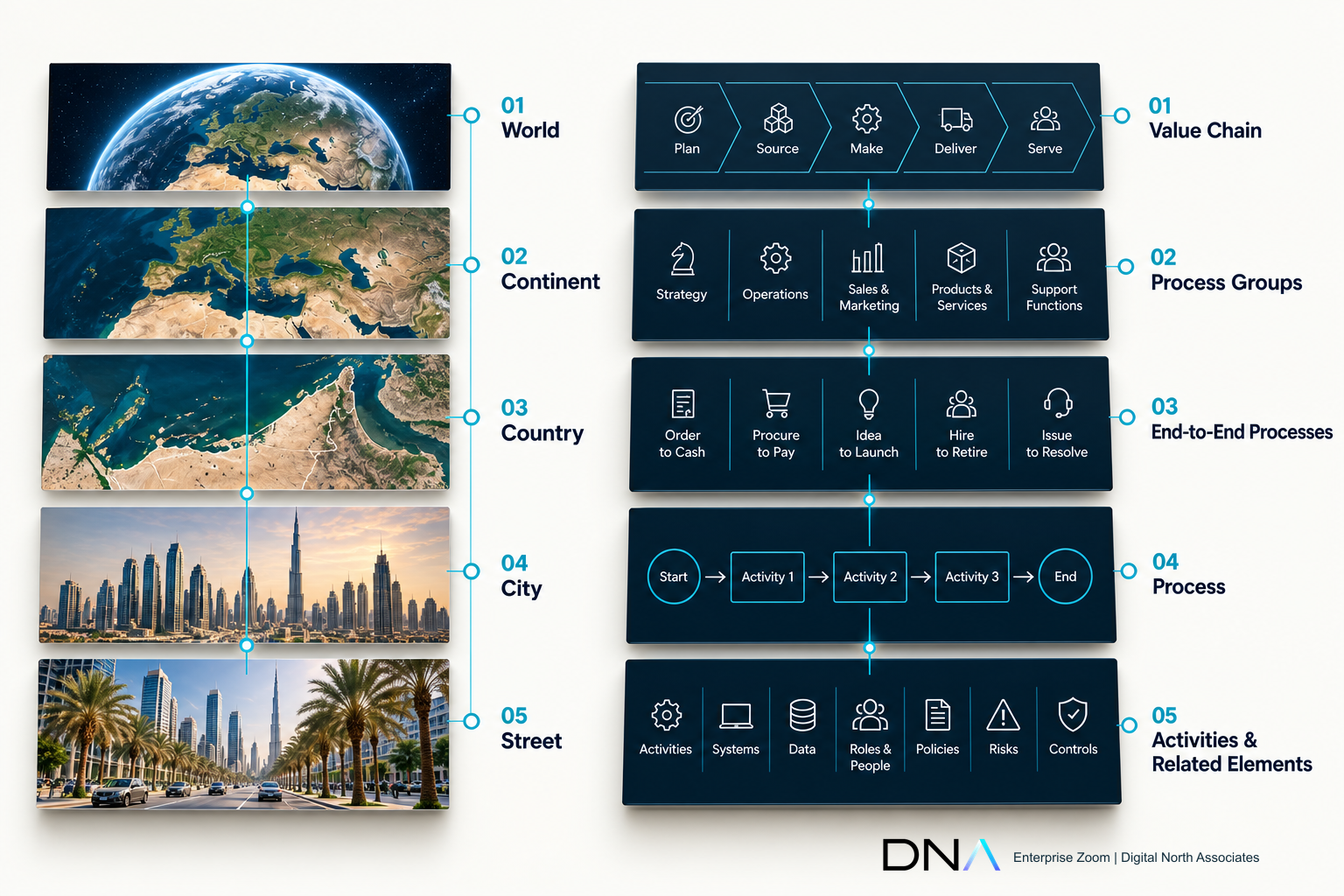
Understand how value is created and how work is organized across the enterprise.
Move into end-to-end processes, individual processes and the activities within them.
See the people, systems and rules behind the work, with its wider context still in view.
The illustration shows example levels and relationships, rather than a universal process hierarchy.
Before we begin
A business process consultant maps how work really flows through an organization, finds where it loses time, money or control, and redesigns it with the people who run it. The visible outputs are process architectures, current-state and future-state maps and a governance model; the real outcome is an organization that can see and change how it operates without starting an archaeology project each time.
Three ways. We are specialists: process, policy and governance are our core business rather than one shelf in a large catalogue. We build for continuity: every engagement leaves a governed, living process model and trained owners, not a binder. And we are AI-native: we treat the process model as the foundation AI and automation stand on, which changes what good documentation looks like.
A focused mapping and redesign of a handful of critical processes typically runs eight to twelve weeks. A full process architecture with a Center of Excellence is a phased programme over several months. We scope in phases with their own outcomes, so value lands early and the decision to continue is always yours.
Yes. A large share of our work is with government and semi-government entities in the UAE and the wider GCC, where process clarity connects directly to service standards, audit findings and excellence programme results. We are comfortable in both Arabic and English working environments.
Usually partly. We assess what exists against how work runs today, keep what is true, and rebuild what is not. The more important fix is the reason the maps went stale: no ownership and no governance. That is the part we always add, whatever the starting point.
Your next move
Start with the flow that carries the most friction. We will help you find the right place to begin.
Let’s work through it